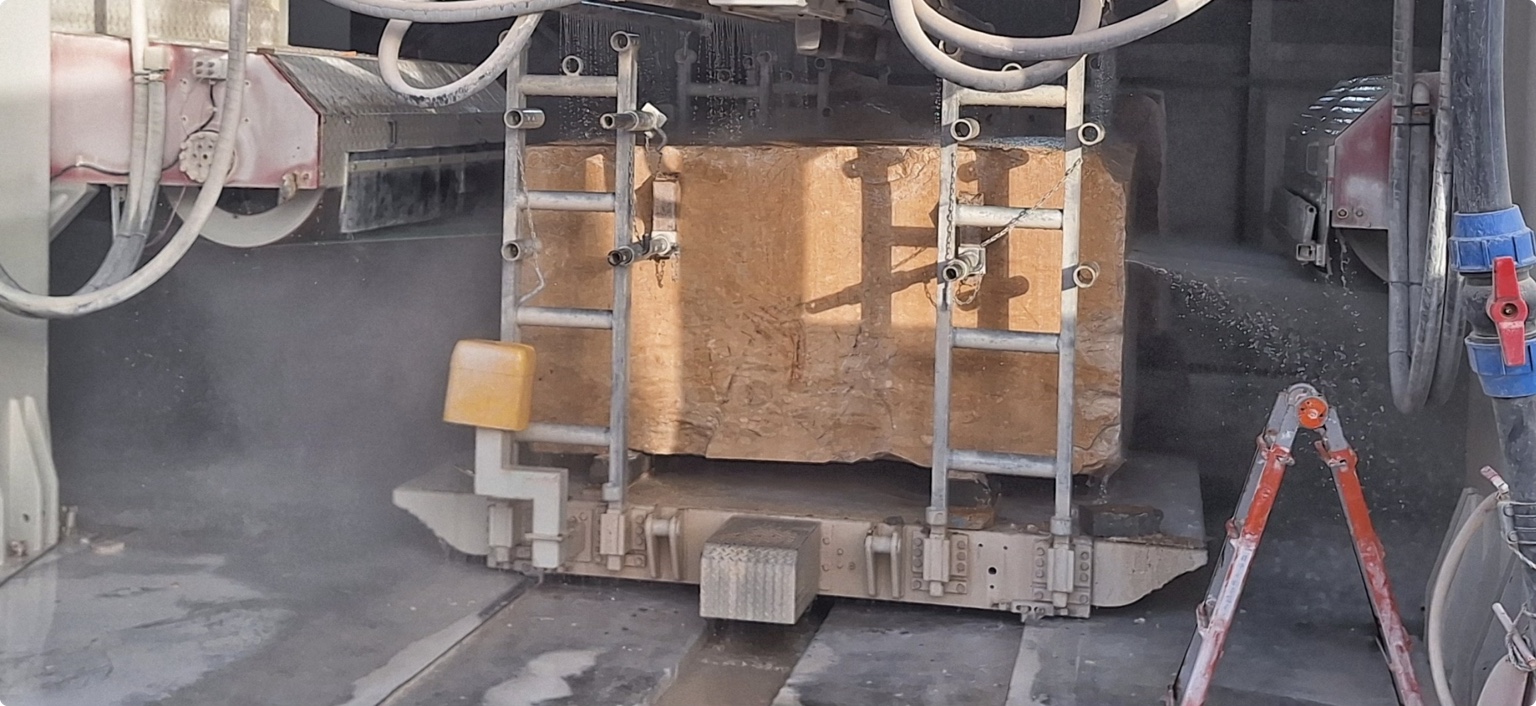
In marble multiwire cutting, working life depends on the complete wire. The bead must maintain its cutting ability, while the cable and coating must support its operation over time.
One challenge has been to make use of the beads’ remaining cutting capacity without having to renew the assembly first. Solutions offered to producers have included replasticising the wires or using second-hand beads with useful working life remaining.
Extending bead use adds another operation
When the beads still have useful cutting capacity but the assembly requires renewal, replasticisation allows them to return to production.
However, the service is not available everywhere. Not every country has replasticisation centres, and in some markets the wires must be sent abroad.
Beyond the operation itself, producers must consider transport, handling and turnaround time. They need to organise the return of the wires and maintain enough usable sets to supply the machine.
Replasticisation can extend bead use, but it introduces an additional stage in the production cycle. Its practical impact depends on how close and accessible the service is.
Remaining working life and consistency between supplies
Another solution has been disposable wire assembled with used beads, still capable of providing approximately 300–400 operating hours.
These were often beads originally developed for quartzite and subsequently adapted to marble. This made use of their remaining diamond capacity, but did not always provide the cutting behaviour or surface quality required by the application.
Repeatability between supplies was also an important limitation.
With used beads, availability determines what can be supplied. Origin, wear condition and remaining diamond layer can vary between batches. A set that performs well may therefore be difficult to reproduce on the following order.
For producers planning regular output, this variability matters alongside remaining working life and purchase price.
New marble beads and a long-life assembly
Diamond Service has focused on combining new beads developed specifically for marble with an assembly capable of supporting a long working cycle without replasticisation.
Development has involved the diamond bead, a reinforced steel cable and a specially developed polymer coating.
In this context, “disposable” means completing the working cycle without intermediate replasticisation.
New beads also allow the specification to be selected around the material and production requirements, with greater consistency between repeat supplies and without depending on the availability of used beads.
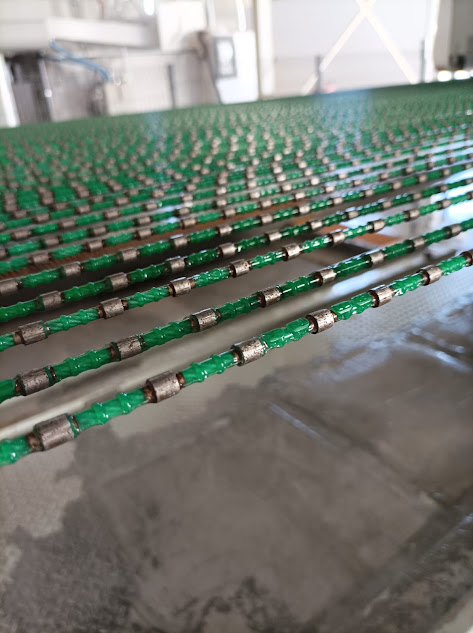
Results with Ø5.3 mm and Ø6.3 mm wire
The latest Diamond Service results are:
| Wire diameter | Working life without replasticisation | Total output on a 40-wire machine |
|---|---|---|
| Ø5.3 mm | Over 600–700 hours | Over 35,000 m² on medium-difficulty marbles |
| Ø6.3 mm | 800 hours | Over 45,000 m² on medium-difficulty marbles |
The square-metre figures refer to the combined output of the complete 40-wire set.
Operating hours and output should be assessed together: production also depends on the productivity achieved and the materials processed. These results therefore do not represent a fixed conversion between hours and square metres.
In the Portugal application, replacing a Ø5.3 mm wire assembled with used beads with the dedicated Diamond Service wire increased working life from approximately 350 to 600 hours, with an excellent sawn finish.
Read the marble multiwire case study in Portugal →
When the sawn surface is part of the product
For producers selling slabs as sawn, the surface left by the wire is already part of the product delivered to the customer.
The issue is particularly apparent on soft materials: cutting lines remain clearly visible, without a subsequent finishing operation to remove them. This can be even more pronounced when beads developed for quartzite are adapted to marble.
To address this requirement, Diamond Service has developed a dedicated bead for achieving a uniform surface without visible cutting lines, comparable to the finish obtained with diamond gangsaw blades.
The development work on Coralina in the Dominican Republic is a practical example: more than a month of on-site work focused on achieving a gangsaw-like sawn finish with diamond wire.
Read the Coralina case study →
Wire selection should therefore consider working life, management of the working cycle and the required surface together. Material, machine condition and operating parameters remain essential to the result.
Information and results are based on Diamond Service application experience. Actual performance depends on material, machine and operating conditions.